Your first vinyl record, a freshly unpacked turntable, and just a few minutes before the first listening session. It is this special atmosphere that makes so many people fall in love with vinyl. But along with the anticipation of warm analog sound, questions often arise: what are the 33, 45, and 78 settings for, how do you lower the tonearm correctly, and what should you do with such a delicate stylus that seems like it could be damaged by a single careless movement?
In fact, getting started with vinyl is much easier than it may seem. You only need to understand a few basic principles, while modern turntables take care of some of the work for you. Let’s go through everything you need for a safe first start in about five minutes.
33⅓, 45, and 78 RPM: What Do the Numbers on a Turntable Mean?
RPM stands for revolutions per minute, meaning the number of times the record rotates in one minute. The speed determines how quickly the stylus travels along the record groove.
If you select the wrong speed, nothing disastrous will happen. A record designed for 33⅓ RPM but played at 45 RPM will sound unnaturally fast, and the singer’s voice will become noticeably higher. If you do the opposite, the music will slow down and the vocals will sound lower. Simply select the correct speed, and the sound will return to normal.
33⅓ RPM is the most common speed for full-length LP (Long Play) albums. These are usually large 12-inch records with a diameter of around 30 cm, with approximately 20–25 minutes of music fitting on each side.
45 RPM is often used for singles and EPs. The classic format is a compact 7-inch record, although 10- and 12-inch releases are also produced at this speed. Some older singles have a large center hole. These require a small round 45 RPM adapter that fits onto the turntable spindle.
78 RPM is much less common today. It is primarily a historical format associated with recordings from the first half of the 20th century. Many of these records were made not from modern vinyl but from shellac compounds, and their grooves are noticeably different in width. Therefore, simply having a 78 RPM mode does not necessarily mean that a standard modern stylus is ideally suited for playing an old shellac record. If you plan to listen to such recordings regularly, it is worth using an appropriate cartridge or a dedicated stylus.
Tonearm and Stylus: Delicate, but Nothing to Be Afraid Of
The stylus, commonly referred to as the needle, travels along the record groove and transmits its microscopic vibrations to the cartridge. It is designed for regular contact with records, so there is no need to worry every time the tonearm touches the vinyl. What matters much more is avoiding sideways pressure on the stylus.
One of the most useful turntable features for beginners is the tonearm cueing lever. Instead of trying to lower the stylus onto the record as carefully as possible with your fingers, simply raise the tonearm with the lever, position it above the beginning of the desired track, and lower the lever. The mechanism will gently lower the stylus into the groove. This is much safer and less stressful, especially during your first listening sessions.
The cartridge’s protective stylus cover also requires some care. Remove it gently without making sudden sideways movements to avoid accidentally touching the cantilever, the thin component that holds the stylus. After listening, the cover can be put back in place. This is especially useful if children or pets can reach the turntable.
The auto-stop function is another useful feature for everyday use. Once the side of the record has finished playing, it stops the platter from rotating, preventing the turntable from running for hours while the stylus remains in the run-out groove.
Four Mistakes to Avoid on Your First Day
The first risky habit is moving the tonearm sideways while the stylus is already resting on the record. The stylus should follow the groove on its own. If you want to skip to another track, first raise the tonearm using the cueing lever, move it above the desired position, and only then lower it again.
The second mistake is cleaning the stylus with your finger, cotton wool, or an ordinary cloth. Fingers naturally carry oils, while fabric fibers can catch on the delicate cantilever. For proper care, it is better to use a dedicated stylus brush and clean the stylus from the rear of the cartridge toward the tip of the needle, not in the opposite direction.
The third situation happens because of haste: the tonearm is lowered past the edge of the record directly onto the slipmat. Its surface is not intended to come into contact with the stylus, so before lowering the tonearm, simply make sure that the needle is positioned above the record itself.
The fourth mistake is common when using a new turntable for the first time: the user forgets to release the tonearm transport lock and tries to move it by force. Before playback, simply check that the tonearm has been released from its retaining clip.
Musicality: When Your First Turntable Does Not Require Complicated Setup
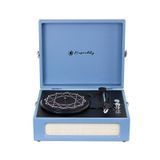
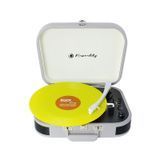
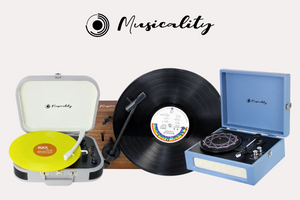
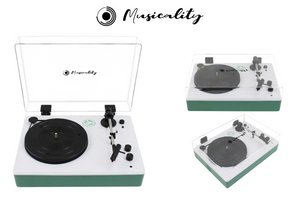
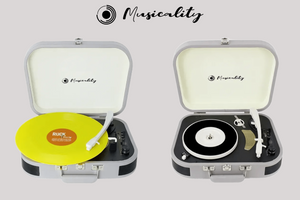
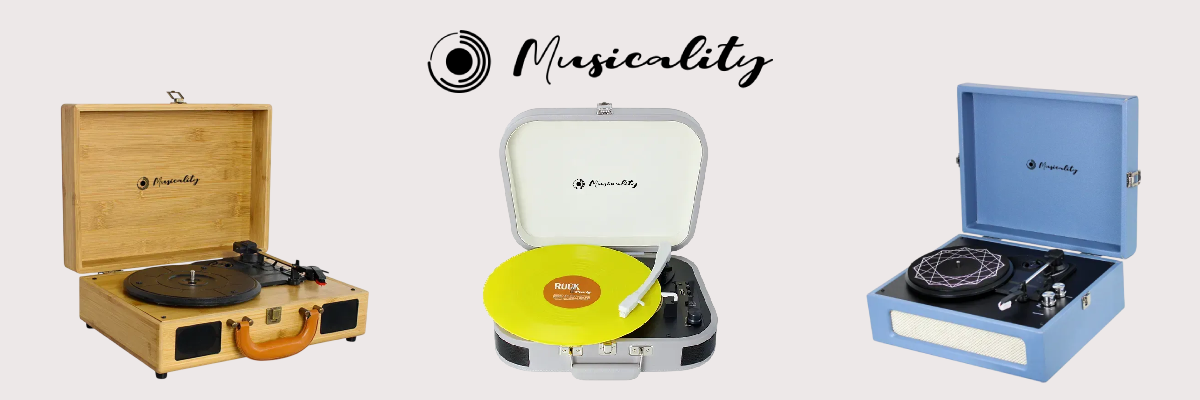
When getting started with vinyl, it is convenient to have the essential functions already combined in a single device. This is exactly the approach behind the Musicality MLD, GTR, and BPL turntables: they support 33⅓, 45, and 78 RPM speeds, feature straight tonearms and belt-drive mechanisms, and come with built-in speakers and a phono preamp. This means you do not have to assemble a separate audio system right away for your first listening session.
Musicality MLD _Melodic comes in a suitcase-style design and is equipped with an RP-102 MM cartridge. The model supports Bluetooth and features RCA, AUX, and 3.5 mm audio connections, while a 45 RPM record adapter is included in the package. The body is made from a combination of wood, MDF, plastic, and artificial leather, while the closed design helps protect the mechanism from dust. - UAH 4,818.
Musicality GTR _GranTurismo also comes in a practical suitcase-style design. It uses an RP-105 MM cartridge, supports Bluetooth and USB, and allows you to connect an external audio system via RCA. AUX and a 3.5 mm connection are also provided, while a 45 RPM adapter is already included in the package. - UAH 5,918.
Musicality BPL _Bamboo Player combines a belt-drive mechanism, three playback speeds, and an RP-102 MM cartridge. The model supports Bluetooth and USB and features built-in speakers and a phono preamp. USB Type-A, RCA, AUX, and a 3.5 mm audio connection are provided for external connectivity. The body is made from wood, MDF, and PVC, while the turntable weighs 4 kg. - UAH 6,798.
Musicality models feature straightforward speed selection and a tonearm cueing lever, allowing the most delicate operation, placing the stylus into the groove, to be performed smoothly and with full control.
First Start: A Six-Step Checklist
- Place the turntable on a flat, solid, and stable surface so that vibrations and accidental bumps do not interfere with playback.
- Place the record on the platter and check the required speed. For most albums, this will be 33⅓ RPM, while many singles use 45 RPM. If the record has a large center hole, install the 45 RPM adapter.
- Carefully remove the protective cover from the stylus and release the tonearm from its retaining clip.
- Move the cueing lever to the raised position so that the tonearm remains above the record.
- Holding the tonearm by the designated part, move it above the beginning of the first track without touching the stylus with your fingers.
- Lower the cueing lever. The stylus will gently settle into the groove, and all that remains is to enjoy the music.
Vinyl Requires Care, Not Complicated Rituals
You do not need dozens of accessories or audiophile expertise to start enjoying records. Selecting the correct speed, handling the tonearm carefully, using the cueing lever, and following basic stylus care practices are enough to safely take your first steps into the world of analog sound.
The MLD, GTR, and BPL models make getting started even easier thanks to support for all three main speeds, a tonearm cueing lever, built-in speakers, and the ability to operate without a complicated external audio system. Once the numbers 33, 45, and 78 stop looking like a mysterious code, the turntable quickly transforms from an unfamiliar piece of equipment into a simple and enjoyable way to listen to your favorite records.
You can explore Musicality models and other vinyl turntables in our catalog.