Modern life rarely leaves room for genuine silence. Sirens, urban transport, an endless stream of notifications, the noise of household appliances, and information overload accompany us from early morning until late at night. Even at home, the brain often continues to operate in a state of heightened alert because the surrounding soundscape does not allow us to fully relax.
That is why people are increasingly looking not for absolute silence, but for a harmonious acoustic environment. Psychologists, mindfulness specialists, and yoga instructors have long observed that natural sounds help restore emotional balance more quickly. The murmur of water, the rustling of leaves, birdsong, or soft resonant vibrations can change our perception of a space within just a few minutes and shift the nervous system from a state of tension into a state of rest.
For this reason, wind music, or chimes, is no longer merely a decorative garden ornament. Today, it is an instrument that helps create a personal acoustic space of calm. A single gentle touch or breath of wind fills the home with delicate sound that does not impose itself, but naturally becomes part of the atmosphere.
From a Sacred Talisman to Imperial Palaces
The history of wind chimes spans thousands of years. Archaeologists have found references to similar instruments in Ancient China, where metal bells were used during religious ceremonies and temple rituals. A special place was held by “ling” bells, which adorned Buddhist shrines and monasteries. Their sound accompanied prayers, meditation, and spiritual practices.
Chimes also played an important role in the culture of Ancient India. It was believed that pure, harmonious sounds cleansed a space, helped maintain inner balance, and supported concentration. This is where the connection between wind chimes and the traditions of Vastu originated, later extending to Feng Shui practices, in which bells were believed to harmonize a space and symbolically protect the home from negative energy.
However, the history of chimes was not limited to spiritual traditions. In different countries, they also served a practical purpose. Their movement was used to determine wind direction, assess changes in the weather, and even act as a distinctive acoustic signal in large estates and palaces.
Over time, artisans began paying increasing attention not only to the appearance of the objects, but also to the precision of their sound. In this way, an ordinary household item gradually evolved into a musical instrument in which the length of the resonators, the materials, the balance of the structure, and the accurate tuning of each note became essential.
Why Is the Sound of Chimes So Calming? A Scientific Explanation
Despite their centuries-old history, the modern popularity of wind chimes is explained by more than tradition alone. Research in psychology and neurophysiology suggests that harmonious sounds can have a positive effect on a person’s emotional state.
When we hear smooth, resonant tones with natural pauses between them, the brain gradually reduces its level of tension. Breathing becomes slower, the heart rate stabilizes, and attention naturally focuses on a single source of sound. This is the principle behind modern sound healing practices, which use various acoustic instruments to create a state of deep relaxation.
The material of the instrument itself also plays an important role. Bamboo has natural acoustic qualities that produce a soft, warm, and organic tone. Unlike fully metal chimes, which can sound rather sharp and bright, bamboo models create a delicate, enveloping sound that does not overwhelm the hearing even during prolonged use.
This is why chimes are now widely used in yoga studios, psychologists’ offices, meditation centers, and mindfulness practices. They are used to mark the beginning of a session, the end of savasana, the transition between stages of meditation, or simply as an acoustic reference point that helps bring attention back to the present moment.
Acoustic Comfort as a New Element of Modern Interior Design
In recent years, designers have increasingly discussed not only visual comfort, but acoustic comfort as well. After all, the atmosphere of a home is shaped not only by colors, furniture, or lighting. The sounds that accompany our everyday life are equally important.
That is why wind chimes fit harmoniously into today’s popular interiors in hygge, minimalist, Japandi, or eco styles. Natural bamboo, organic shapes, and restrained design combine beautifully with wood, linen, stone, and living plants, creating a sense of natural simplicity without unnecessary decorative elements.
The best place for chimes depends on your habits. Near a window, they will respond to the slightest movement of air. On a terrace or balcony, their sound can become part of your morning coffee or evening relaxation. In a bedroom or meditation area, you can gently set the pendulum in motion yourself, turning a few moments of silence into a personal ritual of recovery after a busy day.
Small habits like these often create a sense of psychological comfort, when even a few seconds of familiar sound can help you shift more quickly from the pace of work to the calm of home.
Musicality Chakra: A Modern Expression of Centuries-Old Traditions
Whereas ancient artisans once tuned musical instruments by relying on their own hearing and years of experience, modern technologies make it possible to achieve a much higher degree of acoustic precision. The Musicality Chakra series was created according to this principle, combining the traditional philosophy of chimes with a professional approach to acoustics.
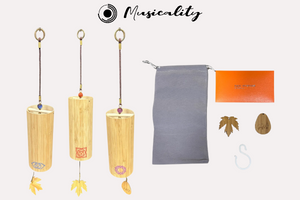
Each Musicality Chakra model is not a souvenir, but a professionally tuned musical instrument. Every chime corresponds to a specific musical note from C to B and is also symbolically associated with one of the seven chakras, beginning with the grounding Muladhara and ending with the spiritual Sahasrara. This approach makes it possible to choose a model not only by its appearance, but also by the character of its sound.
The body of each instrument is made from natural bamboo. This material provides excellent durability, structural stability, and a naturally warm tone that is especially valued during meditation, mindfulness practices, and everyday use at home.
The package has been thoughtfully designed down to the smallest detail. Together with the chime, the owner receives a protective case for safe storage and transportation, two interchangeable pendulums, one shaped like a drop with the brand logo and the other shaped like a maple leaf, an additional plastic suspension accessory, and detailed instructions. This makes it easy to adapt the instrument to personal preferences and different conditions of use.
Another important advantage of the series is its affordability. Regardless of the selected note or corresponding chakra, each model costs 1,357 hryvnias. This makes Musicality Chakra an excellent gift idea for someone who values harmony, high-quality sound, natural materials, and aesthetically pleasing objects with genuine meaning.
Harmony Begins with a Single Sound
Wind chimes have come a long way from the temple bells of Ancient China and India to modern yoga studios, designer interiors, and home relaxation spaces. Over the centuries, materials, technologies, and manufacturing methods have changed, but the most important thing has remained the same. Harmonious sound still helps a person slow down for at least a few minutes, regain inner balance, and return their attention to themselves.
If you have been looking for a way to make your home not only more beautiful, but also more peaceful, professionally tuned bamboo chimes may be exactly the detail that transforms the atmosphere of your space. Visit the catalog at musicality.ua, listen to the sound of each model in the Musicality Chakra series, find your note, or gradually build a complete collection to create your own space of harmony and comprehensive sound therapy.